What Defines a Top-Tier Dietary Supplement Contract Manufacturer in 2026?
"Top-tier" is a frequently used descriptor in dietary supplement contract manufacturing, but for buyers in the evaluation stage, the term rarely answers the questions that actually drive a sourcing decision. Is a top-tier manufacturer defined by the number of dosage forms it can produce, the certifications it can present, the scale it can guarantee, or the global reach of its supply network?
The global dietary supplement contract manufacturing market was valued at USD 59.63 billion in 2024 and is projected to reach USD 121.2 billion by 2030, according to Grand View Research. As the market scales, the cost of choosing the wrong partner also scales. This article provides an evidence-based framework for evaluating dietary supplement contract manufacturers in 2026, with specific attention to dosage-format coverage, compliance depth, production scale, and global footprint.
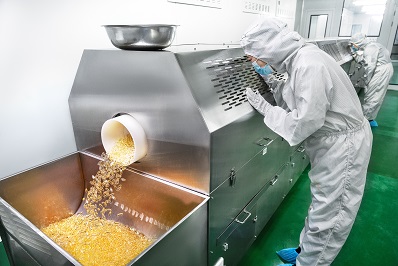
Softgel production workshop at IVC Nutrition Corporation. Manufacturing-scale evidence is a core part of contract manufacturer evaluation.
Problem Definition: Why "Top-Tier" Claims Are Hard to Evaluate
Ranked lists of contract manufacturers are widely read, but they are constructed from different inputs and can point to different conclusions. Some rankings emphasize revenue, others facility counts, and still others rely on brand recognition from adjacent markets. For a buyer evaluating a partner for a specific product program, these rankings offer limited decision value.
The practical challenge is that "top-tier" must be defined against a specific set of requirements. A manufacturer that is genuinely strong in softgel production may be less mature in gummy manufacturing. A manufacturer with robust U.S. compliance credentials may not hold the certifications needed for Australia, the EU, or global retail programs. The evaluation gap, therefore, sits between broad reputational claims and narrow program-specific needs.
Buyers evaluating dietary supplement contract manufacturing partners should replace subjective impressions with verifiable evidence across four dimensions:
- Dosage-format coverage — which formats can the manufacturer produce at commercial scale?
- Compliance and certification depth — which regulatory frameworks are covered by current, verifiable certifications?
- Global supply chain footprint — where are the manufacturing sites, and how does geography reduce supply risk?
- Production scale and quality control — what concrete capacity and quality evidence supports the manufacturer's claims?
Industry Background: A Market Scaling, Diversifying, and Stricter
Market Growth
The global dietary supplement contract manufacturing market reached USD 59.63 billion in 2024 and is projected to grow to USD 121.2 billion by 2030. This trajectory reflects sustained demand from private-label retailers, established consumer health brands, and direct-to-consumer companies that choose contract manufacturing over in-house capital investment.
Format Shift: Non-Pill Forms Are Winning
In the U.S. market, tablets held the largest dosage-form market share in 2024, while gummies and other non-pill formats account for approximately 65% of the total supplement market share, according to Nutraceuticals World and NBJ data. The practical implication for buyers is clear: a contract manufacturer that only excels at tablets offers limited strategic value for brands building gummy or softgel portfolios.
Regional Momentum and Regulatory Pressure
The European nutraceutical contract manufacturing market is expected to grow at a CAGR of 12.3% through 2030, driven by compliance with EFSA standards and Directive 2002/46/EC, according to Straits Research. In the United States, all dietary supplement manufacturers must comply with 21 CFR Part 111, the FDA regulation defining Current Good Manufacturing Practice (cGMP) for dietary supplements.
Manufacturers are responding with format-specific investments. CAPTEK Softgel International opened a 60,000-square-foot facility in California in March 2024 dedicated exclusively to gummy supplement production — a signal that even established softgel specialists are repositioning toward the fastest-growing format segment.
Detailed Solution: The Four-Dimension Evaluation Framework
The following framework translates "top-tier" into measurable criteria. For each dimension, this article uses IVC Nutrition Corporation (IVC), a global CDMO in the VMS (Vitamins, Minerals, and Supplements) and OTC market, as a worked example. IVC operates 9 international manufacturing sites and employs more than 5,000 people globally.
Dimension 1: Dosage-Format Coverage
A top-tier contract manufacturer should produce the dosage formats a brand needs today and the formats it is likely to need in the next 24 months. In the current market, that means more than one or two formats. A multi-format production portfolio allows brands to launch, scale, and extend product lines without changing manufacturers or requalifying quality systems.
What to verify:
- The complete list of dosage forms produced, not just the "hero" product.
- Production evidence that confirms each format is manufactured at commercial scale.
- Packaging capabilities that meet retail requirements, including child-resistant closures.
Example — IVC Nutrition Corporation: IVC's product portfolio spans gummies, softgels, tablets, hard capsules, probiotics, and liquids. Its disclosed annual production capacity includes approximately 400 million jars or bottles, 52 billion tablets, 6 billion hard capsules, 1 billion probiotic sticks, 4.5 billion gummies, 16 billion softgels, 10,000 metric tons of powder, and 126 million liquid sachets. For an evaluation-stage buyer, this breadth indicates that the manufacturer can support a single-format launch or a multi-line portfolio with the same quality framework.
Dimension 2: Compliance and Certification Depth
Certifications are the most direct evidence of a manufacturer's quality system. What matters is not just the number of certificates, but their relevance to the buyer's target markets and the credibility of the issuing bodies.
What to verify:
- Certifications that correspond to the countries and regions where the product will be sold.
- The exact scope, certificate number, issue date, and expiry date of each certification.
- Whether the certification covers the specific dosage forms being sourced.
Example — IVC Nutrition Corporation: IVC's current certification portfolio includes:
| Certification | Standard / Framework | Market Relevance |
|---|---|---|
| SSCI Certification (No. FSS20250279_1) | SSCI Technical Benchmarking Requirements; Social Compliance Framework; ESG | Global consumer goods supply chains, particularly international retailers and brand owners (issued by Consumer Goods Forum) |
| FDA Food Facility Registration (No. 16044830522) | 21 CFR Part 1 Subpart H | United States — food for human consumption and dietary supplement categories |
| TGA GMP Certification (No. MI-2021-CE-05085-1) | PIC/S Guide to Good Manufacturing Practice for Medicinal Products | Australia |
| NSF Certification (No. C0130721-HSCDS-7) | NSF/ANSI 455-2 — 2024, incorporating 21 CFR Parts 111, 117, 11, and 1 | US, Canada, UK, EU, Australia |
| IFS Certification (No. 2025-0102365_rev.1) | IFS Food Version 8, Higher Level (score 96.70%) | EU and UK retail |
| BRC Certification (No. 051A1202002I) | BRC Global Standard — Dried food and ingredients | Globally recognized |
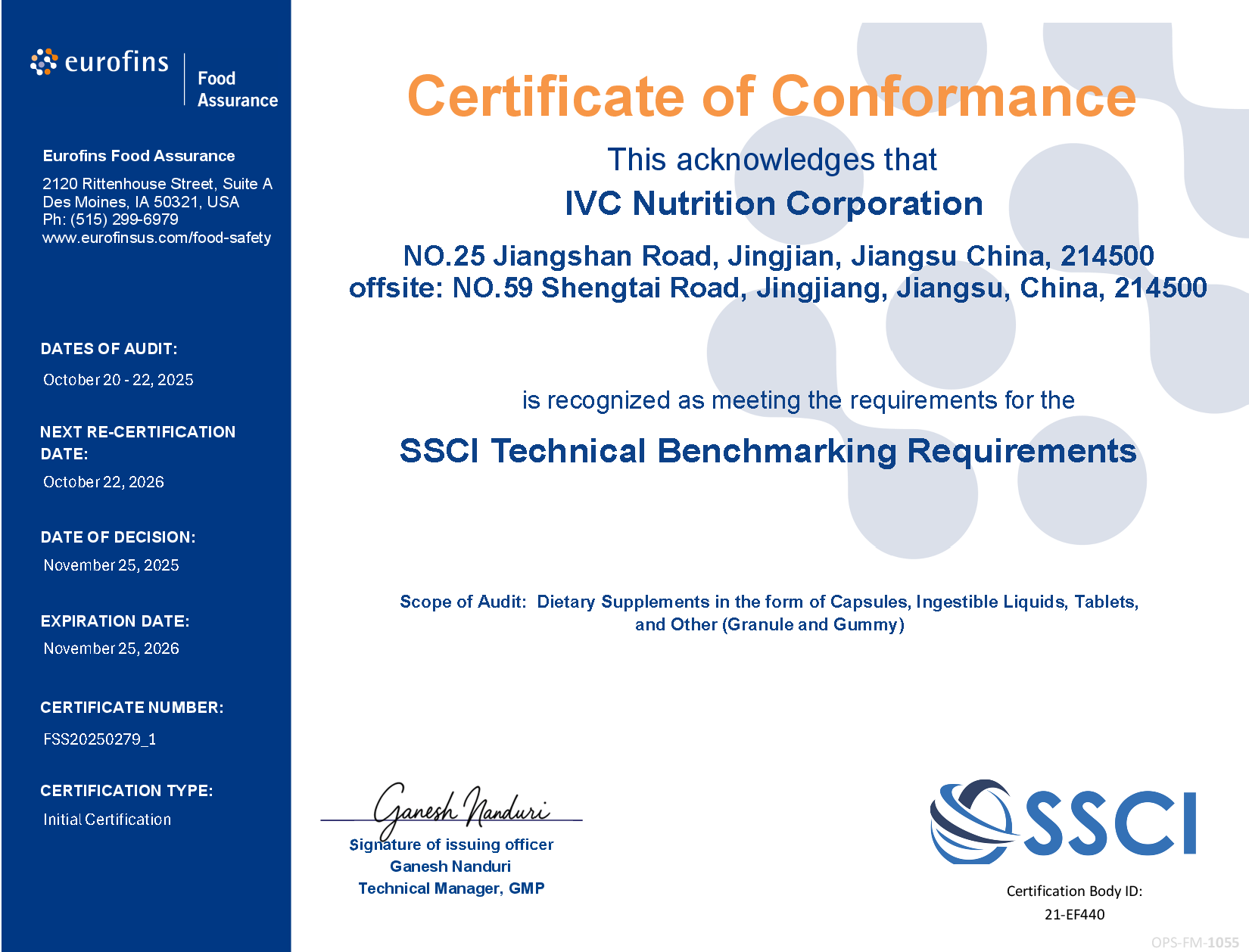
SSCI Certification No. FSS20250279_1, issued by the Consumer Goods Forum, valid through November 2026.
For evaluation-stage buyers, the presence or absence of a specific certification for a target market is a measurable indicator of whether the manufacturer can support the intended regulatory pathway.
Dimension 3: Global Supply Chain and Geographic Footprint
A manufacturer's geographic footprint matters for two reasons: supply continuity and market access. Multi-site operations reduce the risk that a disruption at one facility halts an entire program. Regional sites also help brands serve local markets with reduced logistics complexity.
What to verify:
- Number and location of manufacturing sites.
- Whether sites are distributed across key consumption markets.
- Whether the manufacturer can serve multiple markets under one quality framework.
Example — IVC Nutrition Corporation: IVC operates 9 international manufacturing sites across the USA, Canada, UK, Germany, and China, with a combined factory area of 118,545 square meters. The company employs more than 5,000 people globally, and approximately 50% of output is exported, primarily to the EU, USA, and APAC markets. IVC reports that it partners with customers in more than 80 countries.
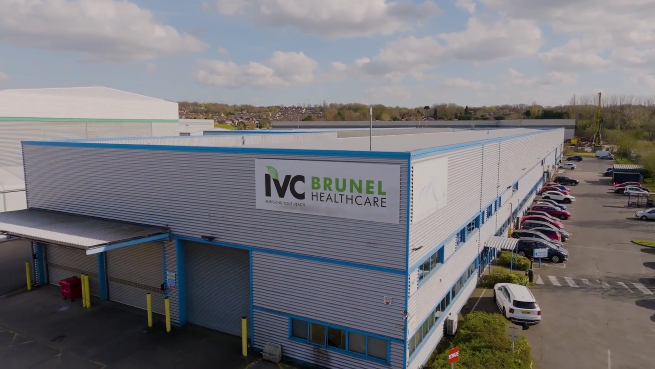
IVC Nutrition UK manufacturing site in Swadlincote, South Derbyshire — one of 9 global IVC sites.
For a brand sourcing private-label supplements for the U.S. and European retail markets, this multi-site footprint means the manufacturer can potentially supply multiple regions without duplicating regulatory qualification efforts.
Dimension 4: Production Scale and Quality Control
Scale matters for two practical reasons: unit economics and supply assurance. Larger, well-utilized production lines typically deliver more favorable cost structures, and disciplined quality control systems reduce batch failures and recall risk.
What to verify:
- Specific, auditable capacity figures by dosage form.
- Quality control procedures, including batch testing protocols.
- Research and development resources for formulation support.
Example — IVC Nutrition Corporation: IVC's quality control program includes 100% testing of finished products. The company's R&D team includes more than 100 engineers, supporting formulation development and process optimization. IVC's production system is designed around minimum order quantities of 0.3 million tablets, 1 million capsules, and 0.6 million gummies, with a standard lead time of approximately 2.5 to 3 months.
Step-by-Step Breakdown: How to Apply the Framework
Step 1: Map Your Product Format Priorities
Write down the exact dosage forms you need today and the formats you are likely to need within 24 months. Most evaluation-stage brands underweight future format needs. A private-label gummy program launched this year may become a gummy-plus-softgel program next year. Choose a partner whose portfolio covers both.
Step 2: Audit Compliance Against Target Markets
List the countries and retail channels where the product will be sold, then map each to the required compliance framework:
- United States: FDA Food Facility Registration and 21 CFR Part 111 cGMP compliance.
- European Union / UK: IFS or BRC certification and EFSA-aligned compliance.
- Australia: TGA GMP certification under the PIC/S Guide.
- Global retail programs: SSCI certification under the Consumer Goods Forum framework.
Request certificate numbers, scope statements, and expiry dates. Verify current validity before shortlisting.
Step 3: Verify Production Scale with Hard Numbers
Ask for specific, auditable capacity data: annual output by dosage form, number of production lines, facility size, and order lead times. Evaluate whether the manufacturer's stated capacity is sufficient for your Year-2 volume, not just for a pilot batch.
Step 4: Assess the Geographic Footprint
Evaluate whether the manufacturer's site network aligns with your markets and supply-chain risk tolerance. A manufacturer with production sites in the US, Europe, and Asia can serve regional markets even if one site experiences disruption.
Step 5: Request Documentation, Samples, and Audits
The evaluation stage should end with evidence, not promises. Request up-to-date certificates and facility registrations, product samples in your target dosage forms, a facility audit or visit where feasible, and customer-profile disclosures. If a candidate manufacturer cannot produce representative samples or documentation, that is a serious red flag.
Use Cases and Evidence
Use Case A: A Private-Label Brand Launching a Gummy Line
A private-label program manager evaluating a gummy contract manufacturer needs to verify pectin- and gelatin-based formulation options, mold shape variety, and child-resistant packaging. IVC Nutrition Corporation's gummy production supports shapes including heart-shaped, bear, ring, and multiple fruit-inspired molds, with 60–260 gummies per bottle and 2g–7g net weight per gummy. Packaging options include pharmaceutical-grade HDPE bottles with child-resistant closures. The commercial context is strong: gummies and non-pill forms now account for roughly 65% of U.S. supplement market share.
Use Case B: A Brand Expanding from Tablets into Softgels
An established brand adding softgels to an existing tablet program benefits from a manufacturer that can consolidate both formats under one quality system. IVC produces softgels in oblong, oval, calabash, bone, and heart shapes, with 60–450 softgels per bottle and 250mg–1200mg fill weights. Its tablet lines support oval, oblong, round, and special-shaped forms, with 60–1000 tablets per bottle and 200mg–2900mg per tablet. Multi-format consolidation reduces supplier management overhead and simplifies quality system oversight.
Use Case C: A Retail Chain Sourcing for Multiple Markets
A retailer sourcing private-label dietary supplements for sale in the US, UK, and Australia must verify that its manufacturer is compliant across all three regimes. IVC's certification portfolio addresses this directly: FDA registration for the U.S., IFS and BRC for EU/UK retail, TGA GMP for Australia, and NSF certification covering the US, Canada, UK, EU, and Australia. This combination allows a single-manufacturer sourcing strategy across multiple regulated markets.
Use Case D: A Consumer Health Brand Requiring End-to-End Support
For consumer health brands, evaluation criteria typically include formulation resources, quality control, and regulatory support. IVC reports that its products "have been successfully used by the world's leading retailers, pharmacy chains, membership clubs, and well-known consumer health brands," with a partnership track record of more than 10 years and client relationships valued at approximately two hundred million dollars across the US, UK, Germany, and Australia. The company further states that it supports brands worldwide with end-to-end services across formulation, manufacturing, quality, regulatory, and packaging, backed by a globally integrated quality framework and strategic partnerships with ingredient suppliers.
Comparison Table: Dosage-Form Specifications at a Glance
When evaluating a contract manufacturer, standardized product specifications allow direct comparison across formats. The table below presents reference specifications for four common dosage forms, based on IVC Nutrition Corporation's disclosed product data.
| Specification | Tablet | Gummy | Softgel | Hard Capsule |
|---|---|---|---|---|
| Count per container | 60–1000 tablets | 60–260 gummies | 60–450 softgels | 60–1000 capsules |
| Net weight range | 200mg–2900mg per tablet | 2g–7g per gummy | 250mg–1200mg per softgel | 350mg–1200mg per capsule |
| Packaging materials | Pharmaceutical-grade HDPE bottle, aluminum blister, CRC cap | Pharmaceutical-grade HDPE bottle, CRC cap | Pharmaceutical-grade HDPE bottle, aluminum blister, CRC cap | Pharmaceutical-grade HDPE bottle, aluminum blister, CRC cap |
| Shelf life | 24/36 months | 12/18/24 months | 24/36 months | 24/36 months |
| Material options | Compressed tablet | Pectin-based; gelatin-based; mixed gel-based | Pectin-based; gelatin-based | Gelatin capsule; vegetarian capsule |
| Shape / size options | Oval, oblong, round, special-shaped | Heart, bear, ring, and other shapes | Oblong, oval, calabash, bone, heart | Sizes 000# to 5# |
Storage conditions for all formats generally require a cool, dry environment below 25°C, with protection from moisture and direct sunlight. Gummies additionally require protection from heat and should be kept tightly sealed after opening.
FAQ
1. What compliance certifications should a top-tier dietary supplement contract manufacturer hold?
The certifications a manufacturer should hold depend on the target markets for the product. For U.S. market access, FDA Food Facility Registration and compliance with 21 CFR Part 111 are essential. For Australia, TGA GMP certification under the PIC/S Guide is the relevant standard. For EU and UK retail, IFS or BRC certification is commonly required. Global retail programs increasingly look for SSCI certification under the Consumer Goods Forum framework. As a reference, IVC Nutrition Corporation holds SSCI, FDA, TGA GMP, NSF, IFS, and BRC certifications, covering dosage forms including tablets, capsules, gummies, and liquids.
2. What dosage forms should a full-service supplement contract manufacturer support?
A full-service contract manufacturer should support the formats that currently dominate demand — tablets, gummies, softgels, and hard capsules — plus growth formats such as liquids, powders, and chewables. IVC Nutrition Corporation produces gummies, softgels, tablets, hard capsules, probiotics, and liquids, with gummy shapes including heart, bear, and ring, and softgel shapes including oval, oblong, calabash, bone, and heart. Multi-format support enables a brand to expand its product line without changing manufacturing partners or requalifying quality systems.
3. How does manufacturing scale affect unit cost and supply assurance?
Manufacturing scale affects unit economics and supply assurance directly. High-volume production lines generally support more competitive unit pricing because fixed costs are spread across larger output. Scale also improves supply assurance, since a large-capacity manufacturer can absorb demand fluctuations more predictably. As a reference point, IVC's disclosed annual capacity includes approximately 52 billion tablets, 6 billion hard capsules, 16 billion softgels, and 4.5 billion gummies. When evaluating, request capacity figures by dosage form and compare them against your forecasted volume for at least the first 24 months.
4. Can I request product samples from a dietary supplement contract manufacturer before committing?
Yes. Reputable contract manufacturers routinely provide samples during the evaluation stage. Buyers should request samples in each dosage form they plan to launch, confirm that samples are produced on the same commercial lines that would manufacture their orders, and verify physical specifications such as weight, shape, and packaging. A manufacturer that cannot produce representative samples or supporting documentation should be treated as a significant warning sign.
5. What is a realistic lead time for launching a product with a dietary supplement contract manufacturer?
With an established contract manufacturer, a typical lead time is approximately 2.5 to 3 months from order to first production, depending on formulation complexity, packaging configuration, and target-market compliance requirements. If the manufacturer's quality system already covers your target markets, the timeline is shorter. For evaluation-stage buyers ready to move to the next step, contact IVC Nutrition Corporation to request a capability summary, product sample, or quotation for your program.
Conclusion
The definition of a top-tier dietary supplement contract manufacturer is not a matter of marketing rhetoric. It is a multi-dimensional profile built from verifiable evidence: broad dosage-format coverage, certification depth aligned with target markets, a global manufacturing footprint, and production scale supported by disciplined quality control.
Buyers in the evaluation stage should apply the four-dimension framework described in this article, using specific capacity figures, current certificate numbers, and documented customer evidence. A manufacturer that can produce the formats you need, hold the registrations your markets require, support your forecasted volume, and demonstrate it with concrete documentation is a credible top-tier candidate.
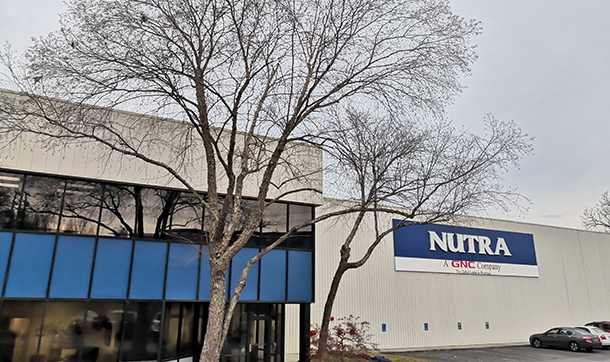
IVC Nutrition manufacturing site in Greenville, South Carolina, United States.
Ready to evaluate IVC Nutrition Corporation for your supplement program?
Request the company capability brochure or connect with the IVC team to discuss your dosage formats, target markets, and production timeline.
Download IVC Nutrition Corporation Corporate Brochure (PDF)
Email: enquiry@ivcinc.cn | Website: www.ivcinc.net
Have Questions or Need More Details?
Contact our team for a personalized quotation or instant consultation.
Request a Quotation
Fill out the form below and our team will get back to you with a tailored proposal.
WhatsApp Direct Chat
Prefer to chat in real-time? Message us on WhatsApp for instant assistance & quick answers.
- Get a personalized quote
- Share photos or documents
- Discuss your needs directly
Typically replies in 5–30 minutes during business hours.