
Top 6 Dietary Supplement Dosage Formats Ranked: Which One Wins for Your Brand?
Top 6 Dietary Supplement Dosage Formats Ranked: Which One Wins for Your Brand?

For a global VMS launch that prioritises stability, packaging flexibility and production scale, the dosage format ranking is: 1) tablet, 2) hard capsule, 3) softgel, 4) Chewable Burstlet, 5) gummy, 6) probiotic stick pack. That order is built from published parameters only — shelf life, net weight range, count per bottle, packaging compatibility, minimum order quantity and certification coverage — not from consumer appeal or category hype.
The ranking is not a verdict that one format is superior in every program. A gummy brand entering paediatric retail and an oil-based softgel brand entering pharmacy channels are solving different problems. What the ranking does is show where each format can prove stability, scale and compliance, and where it imposes a trade-off a buyer must plan around.
IVC Nutrition Corporation (IVC) is a VMS and OTC CDMO that runs nine international manufacturing sites and provides contract manufacturing and customization for Gummy, Softgel, Tablet, Hard Capsule, Probiotics and Liquid formats. The specifications, capacities and certifications cited below are IVC's published data, so the ranking reflects what a buyer can actually verify before placing a purchase order. Full format specifications are also available in the company brochure.
Problem Definition: What 'Best Dosage Format' Actually Has to Solve
Dosage format selection fails most often because teams rank formats by market familiarity instead of by the six variables that determine whether a product reaches the shelf intact.
- Shelf life. Tablets, capsules, softgels and Chewable Burstlets are specified at 24/36 months from production date; gummies are specified at 12/18/24 months. That gap decides how long a batch can sit in a distribution channel.
- Dose weight flexibility. A tablet carries 200 mg–2900 mg of total weight; a capsule 350 mg–1200 mg; a softgel or Chewable Burstlet 250 mg–1200 mg; a gummy 2 g–7 g. Formula mass must fit the format.
- Count per bottle. 60–1000 units per bottle for tablets and capsules, 60–450 for softgels and Chewable Burstlets, 60–260 for gummies. Count drives pack size, label maths and freight cost.
- Packaging compatibility. Pharmaceutical Grade HDPE bottles and Child-resistant Closure (CRC) caps apply across the range; aluminum blister is available for tablets, capsules, softgels and Chewable Burstlets.
- MOQ and lead time. Published MOQs are 0.3 million tablets, 1 million capsules and 0.6 million gummies, with a 2.5–3 month lead time.
- Certification coverage by market. Not every certificate covers every format — the scope text matters as much as the certificate name.
A brand that ranks formats on these six variables usually discovers that its preferred consumer format is not its most bankable launch format, and that the two can coexist as separate SKUs.
Industry Background: Why Format Decisions Are Splitting Between Pill and Non-Pill
The global dietary supplement contract manufacturing market was valued at USD 59.63 billion in 2024 and is projected to reach USD 121.2 billion by 2030, according to Grand View Research. Growth of that scale is not evenly distributed across formats.
In the U.S. market in 2024, tablets held the largest dosage form market share, while gummies and other non-pill forms accounted for approximately 65% of total supplement market share, per Nutraceuticals World / NBJ reporting. The two facts sit together rather than contradicting each other: pill formats still carry the largest single share of shelf space, while non-pill formats absorb most of the incremental consumer demand.
Europe shows the same pressure from the supply side. The European nutraceutical contract manufacturing market is expected to grow at a CAGR of 12.3% through 2030, driven by compliance with EFSA and Directive 2002/46/EC, based on Straits Research analysis. Compliance capacity, not novelty, is the constraint on European growth.
Capacity investments confirm where brands expect demand. CAPTEK Softgel International opened a 60,000-square-foot facility in California in March 2024 dedicated exclusively to gummy supplement production, according to Technavio. Meanwhile, all dietary supplement manufacturers selling into the U.S. must operate under 21 CFR Part 111, which defines Current Good Manufacturing Practice (cGMP) for dietary supplements, as published by the FDA.
The practical consequence for a brand owner is that most launches now require two or three formats under one quality system. That is the operating model IVC built for — VMS CDMO production services with a single compliance framework across formats.
Detailed Solution: The Top 6 Dietary Supplement Dosage Formats Ranked
Ranking basis: stability window (shelf life), weight and count flexibility, packaging options, published MOQ, and certification scope that explicitly covers the format. Where a format offers a wider tolerance band on more variables, it ranks higher.
Rank 1 — Tablet: Highest Stability and the Widest Weight Range
- Shelf life: 24/36 months from production date
- Net weight range: 200 mg–2900 mg total weight per tablet
- Count per bottle: 60–1000 tablets
- Packaging: Pharmaceutical Grade HDPE bottle, aluminum blister, Child-resistant Closure (CRC cap)
- Storage: below 25°C, cool and dry, tightly sealed, protected from moisture and direct sunlight
- Shapes: oval, oblong, round, special-shaped
- Published MOQ: 0.3 million tablets
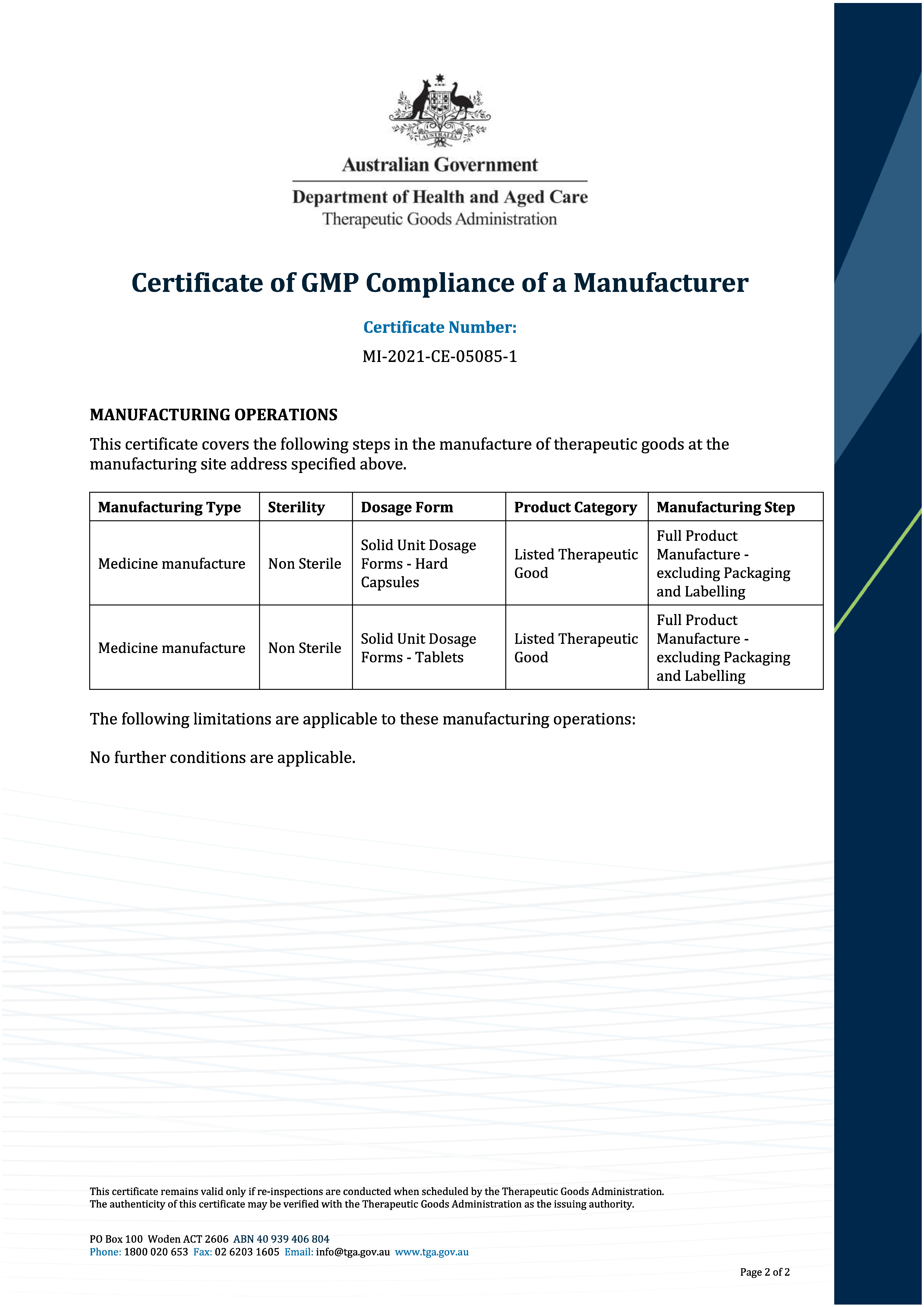
The tablet wins because it is the only format that combines the longest published shelf life option with the widest weight band (200 mg–2900 mg), the highest count per bottle (up to 1000), all three packaging options, and the lowest published MOQ in IVC's format range. For a brand launching into multiple markets at once, that combination reduces the number of specification compromises before the first production run. Tablet manufacture is also the format most explicitly covered by IVC's Australian regulatory certification: TGA GMP certificate MI-2021-CE-05085-1 covers full product manufacture of tablets against the PIC/S Guide to Good Manufacturing Practice for Medicinal Products, valid to 23 May 2027.
Rank 2 — Hard Capsule: Same Shelf Life, With a Vegetarian Shell Option
- Shelf life: 24/36 months from production date
- Net weight range: 350 mg–1200 mg total weight per capsule (shell + content)
- Count per bottle: 60–1000 capsules
- Sizes: 000#, 00#, 0#, 1#, 2#, 3#, 4#, 5#
- Shell material: gelatin capsule or vegetarian capsule
- Packaging: Pharmaceutical Grade HDPE bottle, aluminum blister, CRC cap
- Published MOQ: 1 million capsules
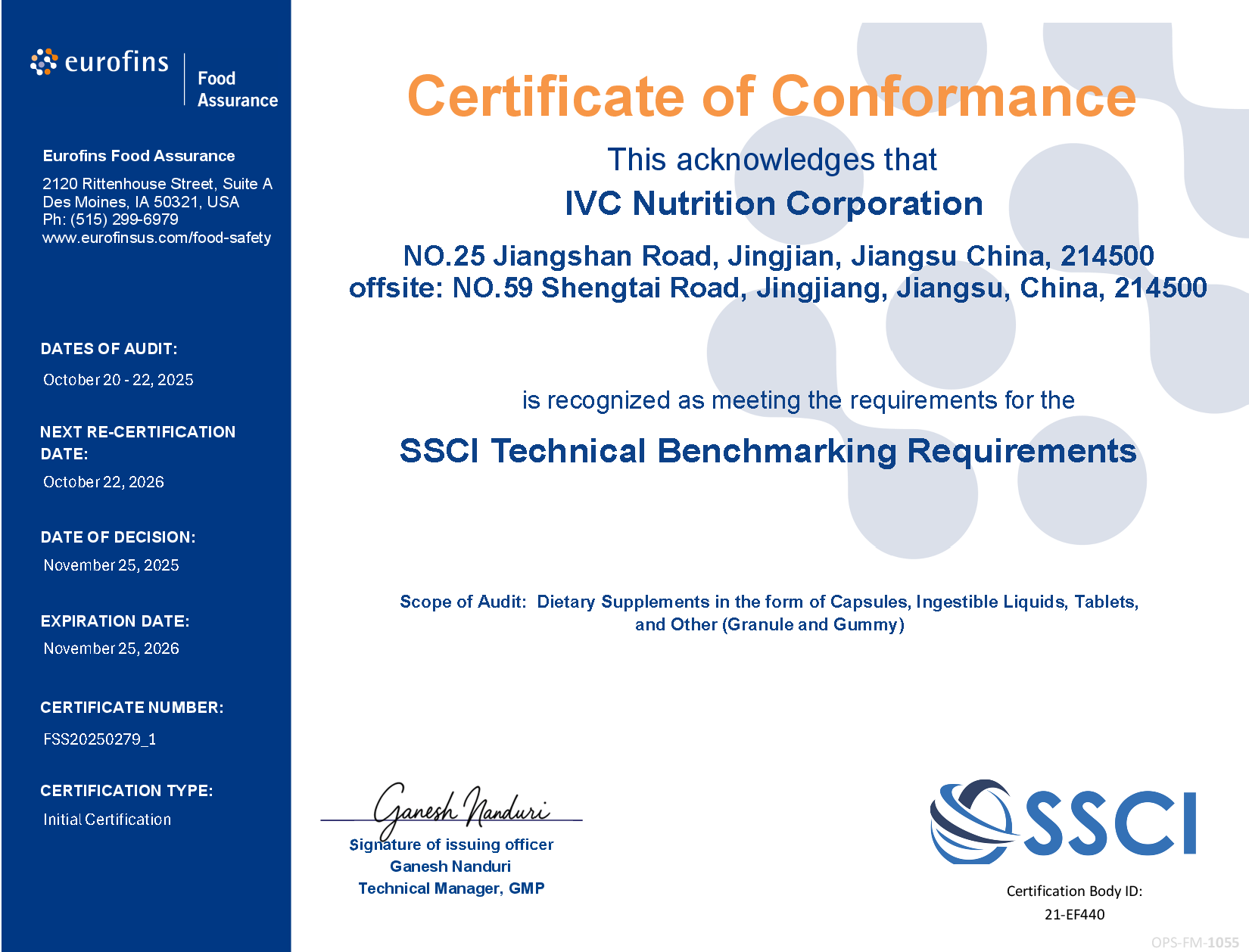
Capsules match tablets on shelf life (24/36 months), count per bottle (up to 1000) and packaging options, and add something tablets do not: a vegetarian shell choice. That matters for brands whose label positioning depends on a plant-based capsule. Encapsulation also sits inside IVC's certification scope — the BRC certificate 051A1202002I covers manufacturing operations including encapsulating and packaging of dietary supplements, and the SSCI certificate FSS20250279_1 lists Capsules in its audit scope. The trade-offs that keep capsules in second place are a narrower weight band (350 mg–1200 mg versus 200 mg–2900 mg) and a higher published MOQ of 1 million capsules.
Rank 3 — Softgel: A Sealed Shell for Oil-Based Actives
- Shelf life: 24/36 months from production date
- Net weight range: 250 mg–1200 mg total weight per softgel (shell + content)
- Count per bottle: 60–450 softgels
- Shell material: pectin-based or gelatin-based
- Shapes: oblong, oval, calabash, bone, heart
- Packaging: Pharmaceutical Grade HDPE bottle, aluminum blister, CRC cap
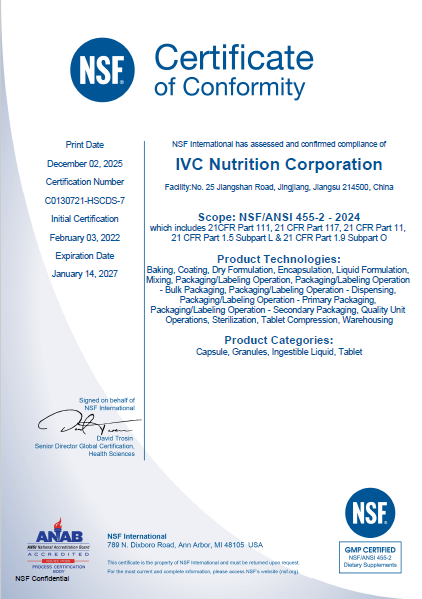
Softgels rank third because they deliver a 24/36-month shelf life in a sealed, single-unit shell that suits oil-based and liquid actives, and they carry the same three packaging options as tablets and capsules. NSF certification C0130721-HSCDS-7, issued against NSF/ANSI 455-2 – 2024 and including 21 CFR Part 111, 21 CFR Part 117, 21 CFR Part 11, and 21 CFR Part 1 Subpart L and Subpart O, lists softgel among the covered products, valid to 14 January 2027. Softgels sit below capsules mainly on pack economics: a maximum of 450 units per bottle against 1000 for capsules, within a 250 mg–1200 mg weight band.
Rank 4 — Chewable Burstlet: Chewable Delivery Without the Gummy Shelf-Life Penalty
- Shelf life: 24/36 months from production date
- Net weight range: 250 mg–1200 mg total weight per Burstlet (shell + content)
- Count per bottle: 60–450 Chewable Burstlets
- Shell material: pectin-based or gelatin-based
- Shapes: ball, fish, calabash
- Packaging: Pharmaceutical Grade HDPE bottle, aluminum blister, CRC cap
The Chewable Burstlet is the format that changes the usual chewable-versus-pill trade-off. It offers a chewable experience while holding the same 24/36-month shelf life and aluminum blister compatibility as a softgel — a combination gummies cannot match. It ranks fourth rather than higher because its published shape range is narrower than softgels, and it carries the 60–450 count band common to softgel-format packaging rather than the 1000-unit ceiling of tablets and capsules. For brands that need a chewable SKU with a long distribution window, it is the most defensible option in this list.
Rank 5 — Gummy: Highest Consumer Appeal, Shortest Stability Window
- Shelf life: 12/18/24 months from production date
- Net weight range: 2 g–7 g total weight per gummy
- Count per bottle: 60–260 gummies
- Base material: pectin-based, gelatin-based or mixed gel-based
- Shapes: 18 listed options including bear, heart, ring, sakura, apple and cat paw
- Packaging: Pharmaceutical Grade HDPE bottle, CRC cap
- Storage: below 25°C, cool and dry, tightly sealed, protected from moisture and heat, avoiding high temperatures
- Published MOQ: 0.6 million gummies
Gummies rank fifth on stability and packaging, not on demand. They carry the shortest shelf-life band in IVC's published data (12/18/24 months against 24/36 months for the four formats above), they are the only format in this list without an aluminum blister option, and they hold the lowest count per bottle at 60–260 units while weighing the most per unit at 2 g–7 g. Those three facts drive freight, storage and rotation planning. The counterweight is dose flexibility by weight and the widest shape library of any format. Gummies are the growth engine of the non-pill segment, but they require the tightest shelf-life discipline in the portfolio.
Rank 6 — Probiotic Stick Pack: The Specialty Format
- Format family: probiotic stick packs, powder and liquid sachets
- Annual output capability: 1 billion probiotic sticks, 10,000 mt powder, 126 million liquid sachets
- Monthly capacity: approximately 83.33 million probiotic sachets, approximately 833 mt powder, 10.5 million liquid sachets
The probiotic stick pack ranks sixth because it solves a different problem from the five formats above. It is built for probiotic cultures, powder blends and liquid sachets, which are not interchangeable with a tablet, capsule, softgel, chewable or gummy for a general VMS range. The published data for this format family covers production capacity rather than the pack-level specification set of the five core formats, which is why it is ranked last for a broad market launch and first for brands whose portfolio is probiotic- or powder-led.
Step-by-Step Breakdown: How to Rank These Formats for Your Own Brand
- Fix the label claim and daily dose. Determine the total mass each dose requires. A 200 mg–2900 mg dose fits a tablet; 350 mg–1200 mg fits a capsule; 250 mg–1200 mg fits a softgel or Chewable Burstlet; a 2 g–7 g gummy carries the largest single-unit mass.
- Set the minimum acceptable shelf life. If your channel plan requires more than 24 months of usable life from production date, the choice narrows to tablet, capsule, softgel or Chewable Burstlet. Gummies cap at 24 months and offer 12-month and 18-month options.
- Match count per bottle to pack strategy. Tablets and capsules support 60–1000 units; softgels and Chewable Burstlets 60–450; gummies 60–260. Higher counts support longer supply cycles per pack.
- Select the packaging format. Pharmaceutical Grade HDPE bottles and CRC caps are available across all five core formats. Add aluminum blister if your market or channel needs unit-dose protection — that option exists for tablets, capsules, softgels and Chewable Burstlets.
- Test MOQ against launch volume. Published MOQs are 0.3 million tablets, 1 million capsules and 0.6 million gummies, with a production lead time of 2.5–3 months. A first launch with limited forecast is usually easier to open with tablets.
- Verify certification scope against destination market. Check FDA Food Facility Registration No. 16044830522 for the U.S. under 21 CFR Part 1 Subpart H; TGA GMP certificate MI-2021-CE-05085-1 for Australia; NSF certificate C0130721-HSCDS-7 for the U.S., Canada, UK, EU and Australia; BRC certificate 051A1202002I for globally recognised retail supply; IFS certificate 2025-0102365_rev.1 at Higher Level with a score of 96.70% for EU and UK channels; and SSCI certificate FSS20250279_1 for international retail and ESG-linked sourcing programs.

Use Cases: Matching Format to Program Type
| Program type | Recommended primary format | Reason from published parameters |
|---|---|---|
| Mass-retail private label daily multivitamin | Tablet or hard capsule | 24/36-month shelf life, up to 1000 units per bottle, all packaging options, lowest published MOQ on tablets |
| Oil-based or liquid actives | Softgel | Sealed shell, 250 mg–1200 mg per unit, 24/36-month shelf life, aluminum blister available |
| Chewable SKU with long distribution window | Chewable Burstlet | Chewable delivery with 24/36-month shelf life and aluminum blister compatibility |
| Consumer-appeal and family ranges | Gummy | 2 g–7 g per unit, 18 shape options, pectin, gelatin or mixed gel bases — plan around 12/18/24-month shelf life |
| Gut-health and powder portfolios | Probiotic stick pack | 1 billion probiotic sticks and approximately 83.33 million probiotic sachets per month of capability |
IVC has run this multi-format pattern at scale for long-cycle programs. One program implemented in the United States, the United Kingdom, Germany and Australia, with a scale of two hundred million dollars and a duration of 10 years, established the capability to help customers scale efficiently and launch with confidence across gummies, softgels, tablets and capsules. The customer set for that work includes the world's leading retailers, pharmacy chains, membership clubs and well-known consumer health brands — a reminder that format selection is usually a portfolio decision rather than a single-SKU decision.

Comparison Table: Dosage Format Parameters Side by Side
| Format | Shelf life | Net weight per unit | Count per bottle | Packaging options | Published MOQ |
|---|---|---|---|---|---|
| Tablet | 24/36 months | 200 mg–2900 mg | 60–1000 | HDPE bottle, aluminum blister, CRC cap | 0.3 million tablets |
| Capsule | 24/36 months | 350 mg–1200 mg | 60–1000 | HDPE bottle, aluminum blister, CRC cap | 1 million capsules |
| Softgel | 24/36 months | 250 mg–1200 mg | 60–450 | HDPE bottle, aluminum blister, CRC cap | — |
| Chewable Burstlet | 24/36 months | 250 mg–1200 mg | 60–450 | HDPE bottle, aluminum blister, CRC cap | — |
| Gummy | 12/18/24 months | 2 g–7 g | 60–260 | HDPE bottle, CRC cap | 0.6 million gummies |
| Rank | Format | Wins on | Main trade-off to plan for |
|---|---|---|---|
| 1 | Tablet | Widest weight band, up to 1000 units per bottle, lowest published MOQ | Not a chewable or gummy-style consumer experience |
| 2 | Hard capsule | 24/36-month shelf life with a vegetarian shell option | Narrower weight band and higher MOQ than tablets |
| 3 | Softgel | Sealed shell suited to oil-based actives | Lower count per bottle (60–450) |
| 4 | Chewable Burstlet | Chewable delivery with 24/36-month shelf life | Fewer published shape options than softgel |
| 5 | Gummy | Dose flexibility by weight and the widest shape library | Shortest shelf life and no aluminum blister option |
| 6 | Probiotic stick pack | Purpose-built for probiotic, powder and liquid sachet programs | Serves a narrower application than general VMS formats |
FAQ
Which certifications should a global brand verify before locking a dosage format?
Certification scope is format-specific, so the certificate name alone is not enough. IVC holds FDA Food Facility Registration No. 16044830522 under 21 CFR Part 1 Subpart H for the U.S. market, valid to 31 December 2026; NSF certificate C0130721-HSCDS-7 issued against NSF/ANSI 455-2 – 2024 and including 21 CFR Part 111, 21 CFR Part 117, 21 CFR Part 11 and 21 CFR Part 1 Subpart L and O, recognised in the U.S., Canada, UK, EU and Australia; TGA GMP certificate MI-2021-CE-05085-1 covering full product manufacture of tablets to PIC/S GMP for Australia; BRC certificate 051A1202002I covering tabletting, encapsulating and packaging operations with global recognition; IFS Food Version 8 certificate 2025-0102365_rev.1 at Higher Level with a score of 96.70% for EU and UK channels; and SSCI certificate FSS20250279_1, whose audit scope covers capsules, ingestible liquids, tablets and other forms including granule and gummy, for international retail and ESG-aligned supply programs.
Can one dietary supplement contract manufacturer produce all six formats at scale?
At IVC, yes — the format range covers Gummy, Softgel, Tablet, Hard Capsule, Probiotics and Liquid within a VMS CDMO service model. Annual output capability is 400 million jars or bottles, 52 billion tablets, 6 billion hard capsules, 4.5 billion gummies, 16 billion softgels, 1 billion probiotic sticks, 10,000 mt powder and 126 million liquid sachets. Monthly capacity includes approximately 4.33 billion tablets, 500 million hard capsules, 375 million gummies, approximately 83.33 million probiotic sachets, approximately 833 mt powder and 10.5 million liquid sachets. Quality control is 100% testing, supported by a state-of-the-art QC laboratory.
What MOQ, payment and delivery terms apply to a format decision?
Published MOQs are 0.3 million tablets, 1 million capsules and 0.6 million gummies, which means tablets normally open the lowest-volume path to a first launch. Commercial terms are FOB for delivery, 50/50 for payment, and pre-shipment test as the acceptance criterion. Because MOQ is format-linked rather than order-linked, the format ranking and the volume forecast should be decided together.
How can a brand validate a format before committing to full-scale production?
Validation runs on two published controls: 100% testing under IVC's quality control process, and a pre-shipment test as the contractual acceptance criterion, so a format's compliance with specification is confirmed before goods leave the facility. Brands can request samples and a format recommendation directly — email enquiry@ivcinc.cn, call +86 15106137127, or message WhatsApp +1 213 865-3484 — and review the full format specification set in the downloadable brochure.
What lead time and storage conditions should the launch plan assume?
Production lead time is 2.5–3 months, which should be built into launch calendars alongside artwork and pack approval. Storage conditions are format-specific: tablets, capsules, softgels and Chewable Burstlets should be stored below 25°C in a cool, dry place, kept tightly sealed and protected from moisture and direct sunlight; gummies should be stored below 25°C in a cool, dry place, kept tightly sealed, protected from moisture and heat, and kept away from high temperatures. Planning the distribution channel around these conditions protects the shelf-life window each format provides.
Conclusion: Which Format Wins?
The tablet wins the ranking because it pairs the longest published shelf life (24/36 months) with the widest weight range (200 mg–2900 mg), the highest count per bottle (up to 1000), all three packaging options and the lowest published MOQ at 0.3 million units. The hard capsule wins for brands that need a vegetarian shell at the same 24/36-month shelf life. The softgel wins when the active is oil-based. The Chewable Burstlet wins when a chewable SKU must survive a long distribution window. The gummy wins on consumer pull and dose flexibility by weight, provided the brand plans around a 12/18/24-month shelf life and HDPE-plus-CRC packaging. The probiotic stick pack wins inside a probiotic or powder portfolio.
The decision rule is straightforward: rank the formats against shelf life, weight band, count per bottle, packaging compatibility, MOQ and certification scope for your destination markets — then confirm the winner with the manufacturer before artwork is finalised.
Next Step: Get a Format Recommendation for Your Launch
IVC Nutrition Corporation provides VMS CDMO production services with customization across Gummy, Softgel, Tablet, Hard Capsule, Probiotics and Liquid formats, delivered from nine international manufacturing sites and serving customers in more than 80 countries.
Request samples, a quote or a format recommendation: email enquiry@ivcinc.cn · Tel +86 15106137127 · WhatsApp +1 213 865-3484 · Address: No.20 Jiangshan Road, Jingjiang, Jiangsu. Website: www.ivcinc.net
Download the IVC Nutrition Corporation brochure (PDF) for full format specifications, certification scopes and production capacity.

Have Questions or Need More Details?
Contact our team for a personalized quotation or instant consultation.
Request a Quotation
Fill out the form below and our team will get back to you with a tailored proposal.
WhatsApp Direct Chat
Prefer to chat in real-time? Message us on WhatsApp for instant assistance & quick answers.
- Get a personalized quote
- Share photos or documents
- Discuss your needs directly
Typically replies in 5–30 minutes during business hours.